Tattoo Pain Chart: Every Body Part Ranked, and What the Research Actually Says
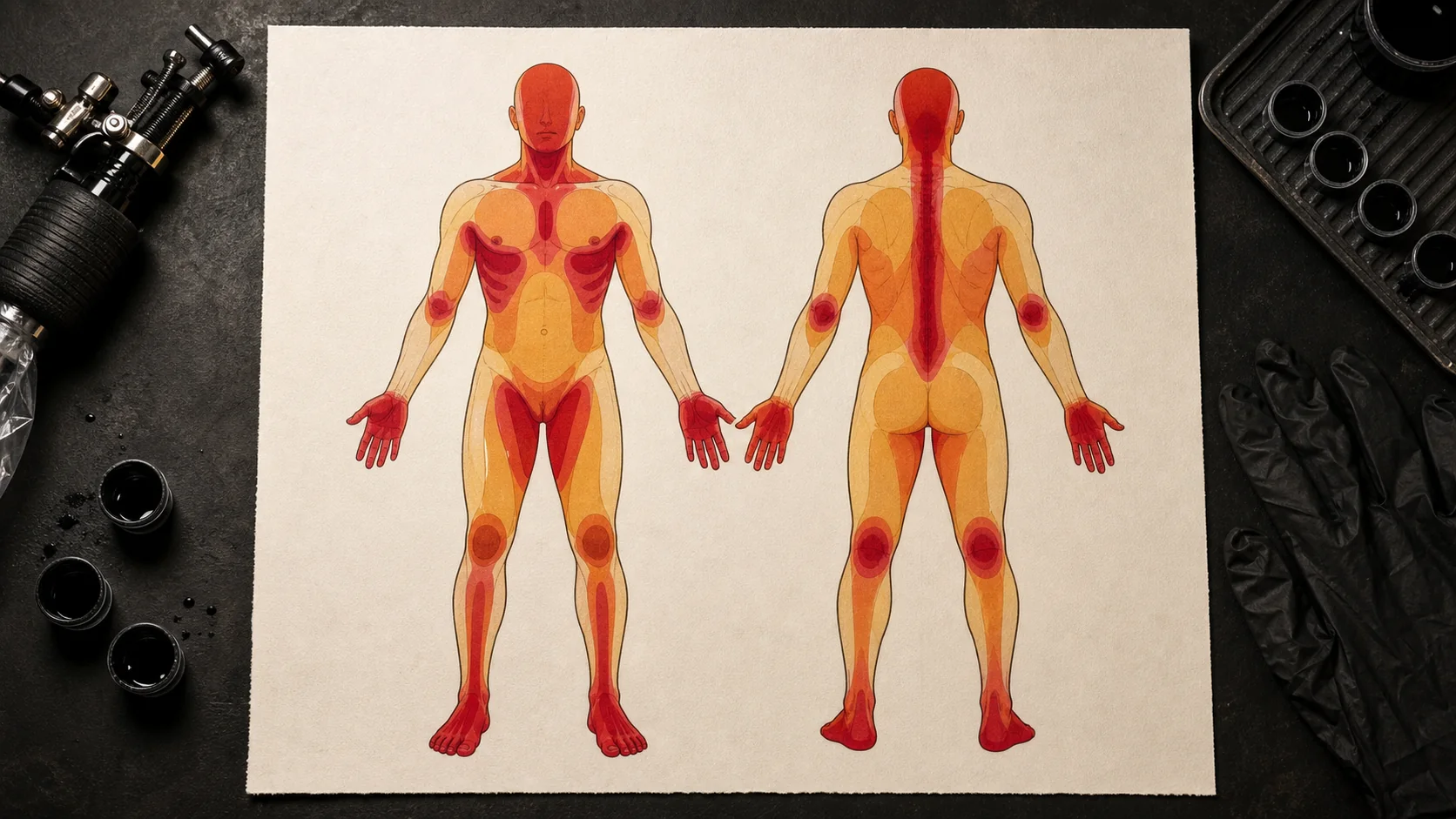
A tattoo pain chart ranks how much each part of the body hurts to tattoo, usually on a 1-to-10 scale. The short version: ribs, sternum, spine, armpit, and the ditch of the elbow are the worst, and outer thigh, upper outer arm, and outer forearm are the easiest places to sit. Everything else falls between.
Now the part most charts leave out. There is no peer-reviewed pain map for tattooing. Every chart you have seen, including the one below, is aggregated artist and client consensus. It is reliable as a planning tool because thousands of tattooers report the same pattern, and because the pattern lines up with what neuroscience knows about how skin is wired. It is not measured data, and anyone presenting it as clinical fact is overselling.
The Chart
Ratings are on a 1-to-10 scale where 1 is a scratch you would forget about and 10 is the kind of pain that ends a session early. Assume your own number lands within a point or two of these.
| Placement | Pain | Why it lands there |
|---|---|---|
| Ribs and sternum | 9–10 | Skin sits straight on bone with almost no fat, and every breath moves the surface under the needle |
| Armpit | 9–10 | Dense nerve bundles, thin skin, lymph nodes right underneath. Most artists will talk you out of it |
| Groin and inner thigh (upper) | 9–10 | Thin skin, high nerve density, nowhere to hide |
| Knee ditch and elbow ditch | 9–10 | Loose stretchy skin over major nerves and tendons, plus the joint keeps wanting to bend |
| Spine | 8–9 | Vertebrae directly under the needle for the entire length of the piece |
| Ankle and shin | 8–9 | Bone with a paper-thin layer over it. The shin gets a sharp vibrating quality people remember |
| Fingers, hands, feet, toes | 8–9 | Highest nerve density on the body, and bone close to the surface everywhere |
| Neck and throat | 8–9 | Thin skin, heavy nerve supply, and a psychological load that makes it feel worse |
| Head, face, and ears | 8–9 | Bone under everything, and the sound of the machine transmits through your skull |
| Nipples and chest (inner) | 8–9 | Nipple tissue is among the most densely innervated skin there is |
| Kneecap and elbow | 7–8 | Bare bone with a thin covering, though the sensation is duller than the ditch |
| Stomach | 6–7 | Varies more than any other spot. Soft skin, but it flinches, and a tense stomach hurts more |
| Inner bicep and inner forearm | 6–7 | Softer, more sensitive skin than the outer side of the same limb |
| Hip and lower back | 5–7 | Fine where there is flesh, sharp where the hip bone surfaces |
| Chest (outer) and collarbone | 5–7 | Comfortable across the pec, rough directly over the collarbone |
| Upper back and shoulder blade | 4–6 | Thicker skin and muscle. Gets sharper as you move toward the spine |
| Calf | 4–5 | Muscle and fat with low nerve density. A common second tattoo |
| Outer forearm | 3–5 | Popular first placement for a reason |
| Upper outer arm and shoulder cap | 2–4 | The classic easiest spot on the body |
| Outer thigh | 2–4 | Thick skin, real cushioning, low nerve density. The gentlest large canvas you have |
Two placements deserve a flag beyond the number. The armpit and the back of the knee are the two most common spots where experienced artists simply say no, or charge a premium and book a short session, because clients rarely finish them.
Why Those Spots Hurt
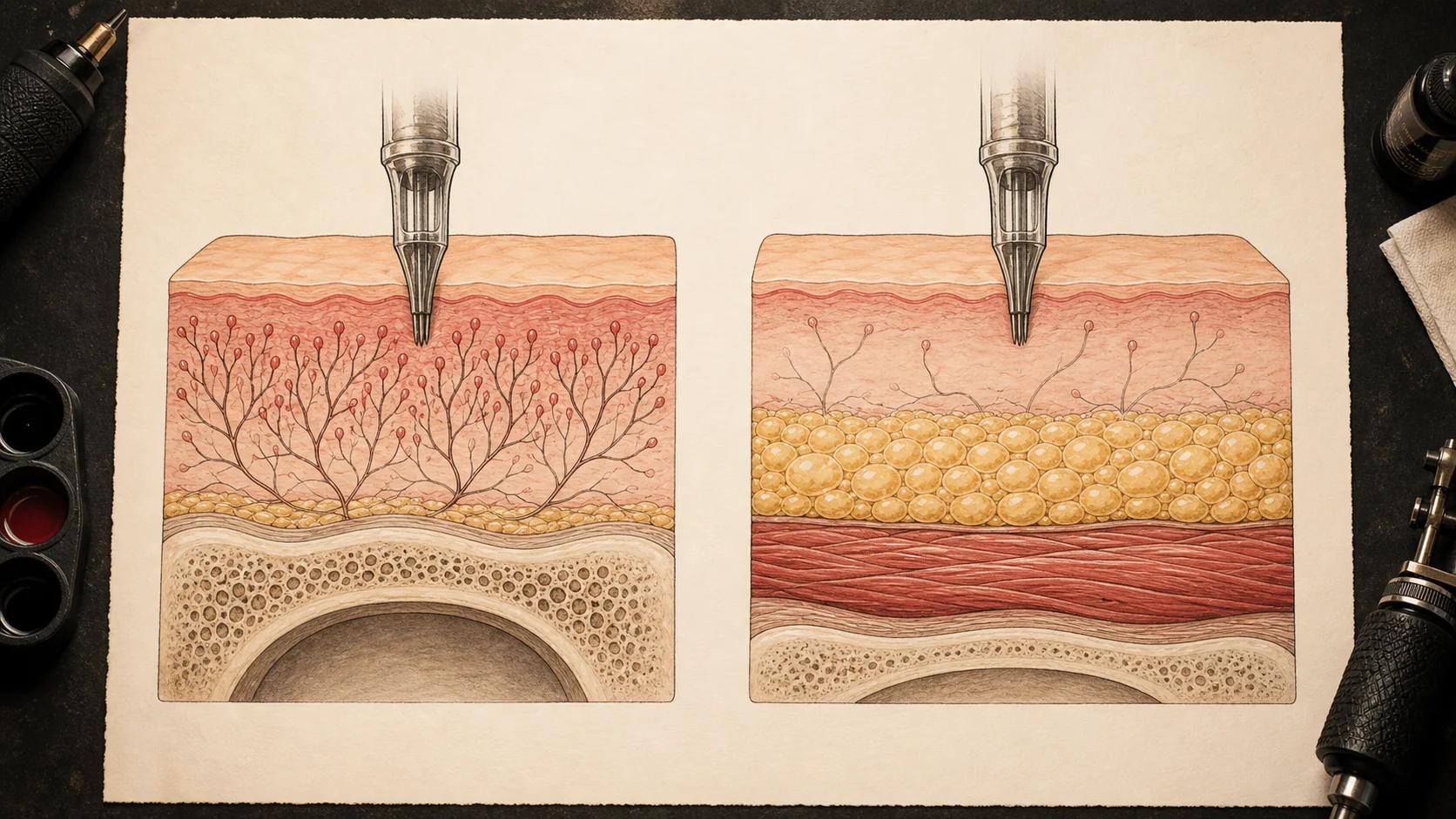
Three things decide the number: how densely that patch of skin is wired, how much fat and muscle sits between the needle and the bone, and how much the skin moves.
The wiring part has real numbers behind it. A 2020 review in the Journal of Neurophysiology put the whole-body total at roughly 230,000 tactile nerve fibers, spread very unevenly. Fingertips carry something like 3,000 to 5,000 Meissner corpuscles per square centimeter. The thenar eminence, the fleshy pad at the base of your thumb only a few centimeters away, carries around 500. That is a six-to-tenfold difference in sensory hardware across the width of a palm, and it is why finger tattoos are a different experience from forearm tattoos.
You can feel the same gradient without any equipment. Standard two-point discrimination testing finds people can tell two touches apart at 2 to 4 mm on the lips and 2 to 8 mm on the fingertips, but need 30 to 40 mm on the shin or back. Skin that reports touch in that much detail also reports damage in that much detail.
Bone is the second factor and it is mostly about cushioning. Fat and muscle absorb vibration and pressure. Where there is none, the needle's impact goes straight into periosteum, and that produces the deep sharp quality people describe on ribs, shins, and the sternum. Skin movement is the third. The elbow ditch, the back of the knee, and the stomach all shift under the needle, which makes the work harder and the session longer.
What the One Real Study Found
There is a single decent peer-reviewed dataset on tattoo pain, and it is worth knowing because two of its findings contradict standard studio advice.
Witkoś and Hartman-Petrycka surveyed 1,092 tattooed people in Poland between June 2019 and June 2020, published in the International Journal of Environmental Research and Public Health. Participants rated pain on a 0-to-10 numerical scale, both during the session and immediately after. 863 were women, 229 were men.
Finding one: there was no difference between women and men in pain reported during tattooing. Directly after, women reported more. So the "women handle it better" and "men handle it better" arguments both lose, at least for the part where the needle is running.
Finding two is the useful one. The researchers ranked what actually predicted higher pain scores, and the coefficients came out like this:
- Painkillers taken before the session — the largest single factor (B = 1.42)
- Stress level going in (B = 0.45)
- Bleeding during the session (B = 0.36)
- Session length (B = 0.35)
Stress outweighed session length. Someone anxious in a two-hour chair reported more pain than someone relaxed in a three-hour chair.
The painkiller result needs an honest reading. This is survey data, so it shows association and not cause. The most likely explanation runs backward: people who expect a lot of pain are the ones who take something beforehand, and they are also the people who report a lot of pain. What the number does do is kill the confident advice that pre-medicating buys you an easier session. There is no evidence here that it does.
Studio advice against aspirin and ibuprofen before a session rests on something separate and better established: both thin the blood, and more bleeding makes the artist's job harder. The same study found bleeding tracked with higher pain scores. Whether to take anything is a question for a doctor, not for a tattoo blog, but the case for "take some ibuprofen first" is weaker than the internet suggests.
Things That Move Pain More Than Placement Does
Placement sets the baseline. These decide where in the range you land, and unlike placement you control all of them.
Sleep and food. Adrenaline carries most people through the first ninety minutes. When it drops, usually somewhere in hour two or three, blood sugar goes with it and pain tolerance falls off a cliff. Eat a real meal beforehand and bring something sugary for the back half of a long session.
Fainting is a blood-pressure event, not a toughness problem. Harvard Health describes vasovagal syncope as a reflex to pain or distress that slows the heart and drops blood pressure, and it accounts for more than half of all fainting episodes. It happens in tattoo shops constantly, to large athletic people as often as anyone. Tell your artist the moment you feel cold, sweaty, or tunnel-visioned, because lying down before you go over is much better than after.
Session length. Skin gets more raw as the hours pass, and the last hour of a five-hour session is not comparable to the first. Two three-hour sittings will hurt less in total than one six-hour marathon, and they cost the same.
What the artist is doing. Outlining is a sharp scratch that moves fast. Shading is a duller burn but covers more skin. Packing solid color is the heaviest on the skin because the same area gets worked repeatedly, which is why a saturated blackwork piece is a longer sit than fine line work of the same size.
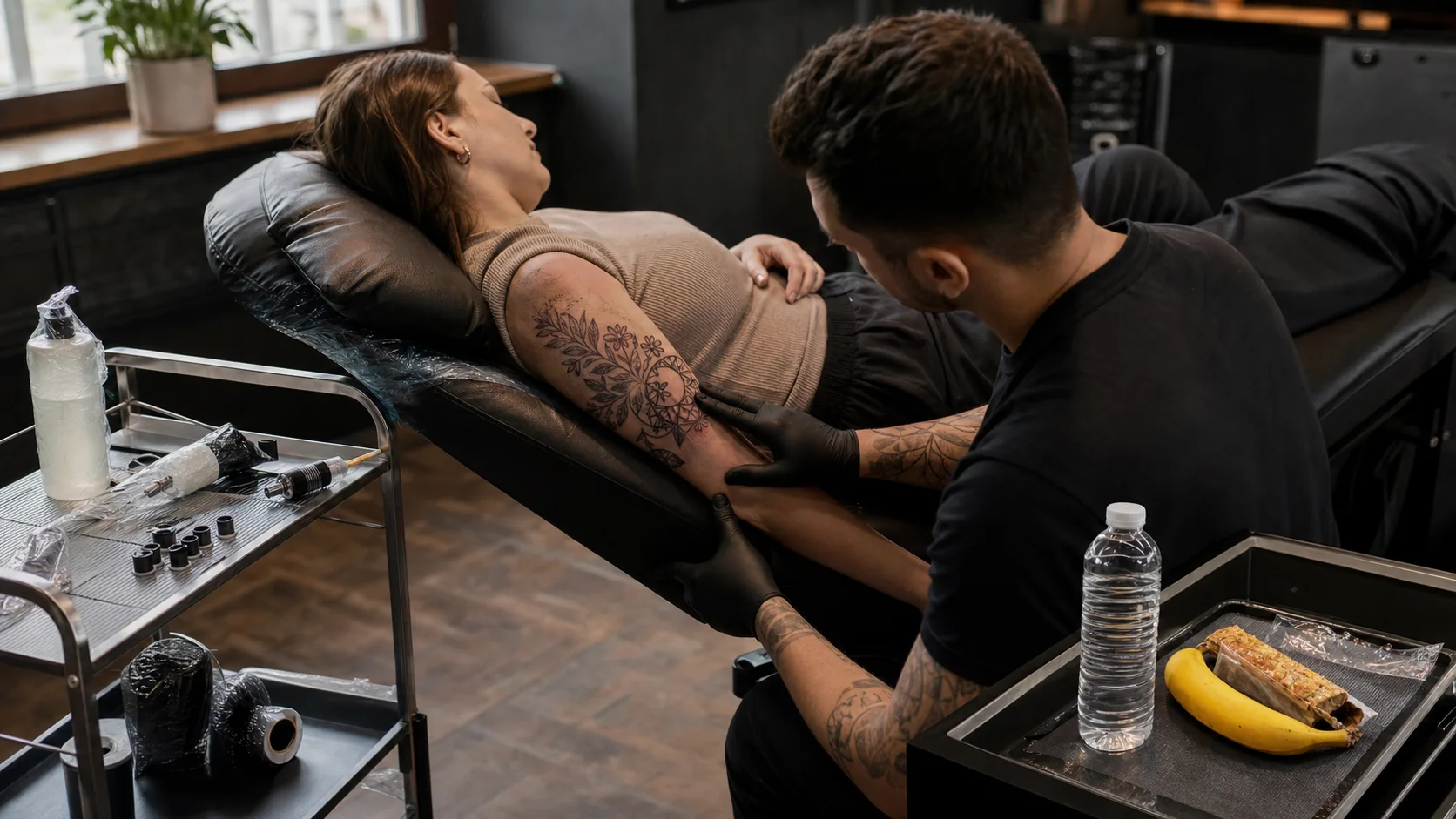
Numbing Creams, and the FDA Position
Numbing creams work. They also carry a real regulatory warning, and a lot of the products marketed to tattoo clients are the ones the warning is about.
The FDA has told consumers to avoid certain over-the-counter topical pain products sold for use before cosmetic procedures including tattooing, because some are labeled at lidocaine concentrations above what is permitted over the counter. Applied over large areas, on broken skin, or under an occlusive wrap, high-concentration lidocaine has been linked to irregular heartbeat, seizures, and breathing problems. The practical lines: nothing above 4% lidocaine over the counter, and no plastic wrap over treated skin, which is exactly the technique most numbing-cream tutorials recommend.
Ask your artist before you buy anything. Plenty of tattooers refuse numbing agents outright, because some formulations change how skin takes ink and how it swells, and because the effect wears off mid-session and leaves the client worse off than if they had never used it. That refusal is a craft judgment about your tattoo, not toughness posturing.
Choosing a Placement You Can Sit Through
For a first tattoo, the honest recommendation is to put it somewhere in the 2-to-5 band and find out what your own tolerance actually is before committing to ribs.
Outer thigh, upper outer arm, and outer forearm give you a comfortable sit, hold detail well long-term, and are easy to keep out of the sun. That last part matters more than pain does over a ten-year horizon. Our guide to first tattoos that hold up goes deeper on the design side of the same decision.
If you already have a spot in mind and you are weighing it against an easier one, look at the design on both before you book. Upload a photo of each placement to the OpenInk try-on tool and you will see the scale and wrap change between, say, a forearm and a rib panel. Size drives session length, session length drives pain, and a piece that looks modest on a phone screen often needs twice the skin you pictured.
When the placement is settled, build the design around it. A rib piece wants a vertical composition and negative space that lets the artist work fast. A thigh piece can carry density that would take three extra painful hours on a shin. Describe the placement in the prompt when you draft it in the OpenInk AI tattoo generator, because the same subject drawn for a forearm and drawn for ribs are two different pieces.
One last thing worth saying plainly. Pain is the part of a tattoo you forget fastest. Placement, size, and whether the design still works in fifteen years are the parts you live with. If a spot is right for the piece, a hard sit is a bad reason to move it.
Related Guides
- 15 First Tattoo Designs You Won't Regret — placement and scale decisions for a first piece
- Fine Line Tattoo Guide — the gentlest style to sit through, and what it costs in longevity
- Blackwork Tattoo Guide — solid fill, long sessions, and what heavy saturation asks of your skin
Frequently asked
What is the most painful place to get a tattoo?
Ribs, sternum, armpit, groin, and the ditch of the elbow or knee all sit at 9 to 10 on a 1-to-10 chart. Skin there lies straight on bone or over dense nerve bundles with no fat to absorb the needle. The armpit and the back of the knee are the two spots experienced artists most often refuse outright, because clients rarely finish them.
Where does a tattoo hurt the least?
Outer thigh and upper outer arm rate 2 to 4, the gentlest places on the body to sit. Both give you thick skin, real cushioning, and low nerve density. Outer forearm at 3 to 5 and calf at 4 to 5 are next, which is why so many first tattoos land there.
Should I take painkillers before getting a tattoo?
There is no evidence it buys you an easier session. In a survey of 1,092 tattooed people, taking painkillers beforehand was the largest single predictor of higher reported pain (B = 1.42), most likely because the people who expect a lot of pain are the ones who pre-medicate. Aspirin and ibuprofen also thin the blood, and bleeding tracked with higher pain scores in the same study. Whether to take anything is a question for a doctor.
Is tattoo numbing cream safe?
Nothing above 4% lidocaine over the counter, and no plastic wrap over treated skin. The FDA has told consumers to avoid certain topical pain products sold for use before tattooing because some are labeled above the permitted over-the-counter concentration; applied over large areas, on broken skin, or under an occlusive wrap, high-concentration lidocaine has been linked to irregular heartbeat, seizures, and breathing problems. Ask your artist first, since plenty refuse numbing agents outright.
Turn this guide into a tattoo draft
Keep the motif from this article, then test style, placement, and line weight before you talk with an artist.