Tattoo Photo Communities Are Where Real References Live Now

You used to be able to search "fine line snake forearm" on Pinterest and get a hundred real tattoos. Now half the results are AI renders of designs no machine could ink and no human ever made. The lines float. The shading sits on top of the skin like a sticker. Nobody made it, nobody can ink it, and there is no artist to message about it.
That is the state of the open feed in 2026, and it is the reason a real tattoo photo community matters more than it did three years ago. If you are gathering references for a piece you actually plan to wear, the place you grew up trusting has quietly turned on you.

This is not a niche annoyance. About 32% of US adults have at least one tattoo, including 22% who have more than one, and among women under 30 the number jumps to 56%. That is a huge group, and most of them start the same way: scrolling for references. The research path is broken for all of them at once.
So here is what this comes down to. Where do tattoo people actually find, save, and verify references now, and how do you read that work before you sit down.
Your tattoo feed turned against you
Pinterest knows it has a problem. In 2025 the platform rolled out "AI modified" labels and a "see fewer" control for categories getting buried in AI slop, after months of users on Reddit complaining the boards they relied on had turned to garbage. By late 2025, users were openly pushing back as AI images flooded the platform — one described getting a one-eyed cat and distorted food in searches, and Pinterest's CEO admitted plainly that no platform can reliably catch every AI image.
For most categories that means slightly worse search. For tattoos it is worse than that, because a tattoo reference has a job to do. It has to be inkable. It has to point at a person who can make it. An AI render fails both tests and still looks convincing in a grid of thumbnails, which is exactly why it is so easy to save the wrong thing without noticing.
Why AI images and lost credit make most feeds useless
Two separate things rot the open feed, and they compound.
The first is the AI renders. They ignore how ink actually behaves. Real tattoo ink spreads a little under the skin, lines soften, fine detail drifts and packs together over years. An AI image never accounts for any of that. It shows you a flawless screen object that no needle could reproduce and no body could keep. Take it to a real artist and the first thing they will tell you is that it cannot be tattooed the way it looks. A screen-only design is not an ink-ready reference, no matter how clean it looks saved.
The second is attribution collapse. Repost and aggregator accounts strip the original artist's handle off the work, so the image you save traces back to nobody. Even the platforms have admitted this is a problem. Instagram updated its algorithm to stop pushing reposted content and surface the original creator instead, on the stated principle that creators deserve credit for what they make. Good intention. It does not fix the screenshot already sitting in your camera roll with no name attached.
A reference with no artist behind it is a dead end. You cannot book an AI image. You cannot ask a phantom reposter how that piece healed or whether the lines held. And you cannot credit the person who actually did the work, which is the bare minimum of how this community is supposed to function.
What a real tattoo reference looks like, and where it lives
A usable reference is a real, healed tattoo photo attached to a named, bookable artist. That is the whole definition. Not a fresh-off-the-needle glamour shot. Not a render. A piece that has settled into skin, made by someone you can actually reach.
The honest options each do part of the job. Reddit's r/tattoos is where you go for blunt feedback and etiquette, less for clean reference-saving. Tattoodo lets you browse photos by style, save favorites to a mood board, and share them with an artist, and it keeps the work attached to the people who made it. Studio and individual artist portfolios, straight from the source, are the gold standard for trust but slow to browse at scale. Tattoo press like Things&Ink is good for culture and discovery, weak as a save tool.

Dedicated tattoo photo communities sit in the gap the others leave open: a browsable feed of real artist work where the credit stays attached when you save. That is what we built the Community Works feed at OpenInk for — real pieces you can browse and keep without losing the artist behind them, with a style gallery to narrow by craft. Booking still happens artist-direct or through a vetted platform, so treat the feed as where references live, not where you check out.
However you save, save responsibly. Keep the artist's name with every image. Curate a tight set instead of dumping fifty screenshots into a folder. And never save something with the plan of asking for a 1:1 copy — the artist holds the copyright on their design, and asking for an exact duplicate of someone else's tattoo is poor form. References inspire. They are not order forms.
How to read healed work before you book
Fresh tattoos lie to you, and not on purpose. The day it is done, a tattoo looks impossibly sharp — swelling tightens everything, plasma gives it a wet shine, ointment makes the colors pop. Then it heals and reality sets in. London realism artist Roudolf Dimov puts it cleanly: "fresh photos are exciting, healed photos are honest," and notes that contrast typically drops something like 15 to 20% as the skin settles. A portfolio of nothing but freshies is showing you the best fifteen minutes of every tattoo's life.

In a healed photo you are looking for blacks that stayed solid, gradients that are smooth with no banding, lines that held their edge instead of bleeding, and saturation that did not wash out. This matters most for realism, black and grey, fine line, and micro work, where there is the least margin and the most to lose. An artist who only ever posts day-of shots is a yellow flag. The good ones show healed pieces because they are confident the work holds up. If you have to ask for healed examples and they do not have any, that tells you something.
Judge work against the right craft, too. Fine line ages differently than blackwork, and dotwork is built on rules of its own. Browse references with the style in mind — our fine line guide and geometric guide walk through what good and bad actually look like in each, so you are vetting an artist against the standard for their lane and not against a different style entirely.
Building a reference board that actually helps your artist
Once you have real, healed, credited work saved, build it into something an artist can use. That means curating by intent — subject, style, placement, scale — rather than handing over a random pile. Artists want a small, clear set that says where you want to go. Twelve images that all point the same direction beat fifty that contradict each other.
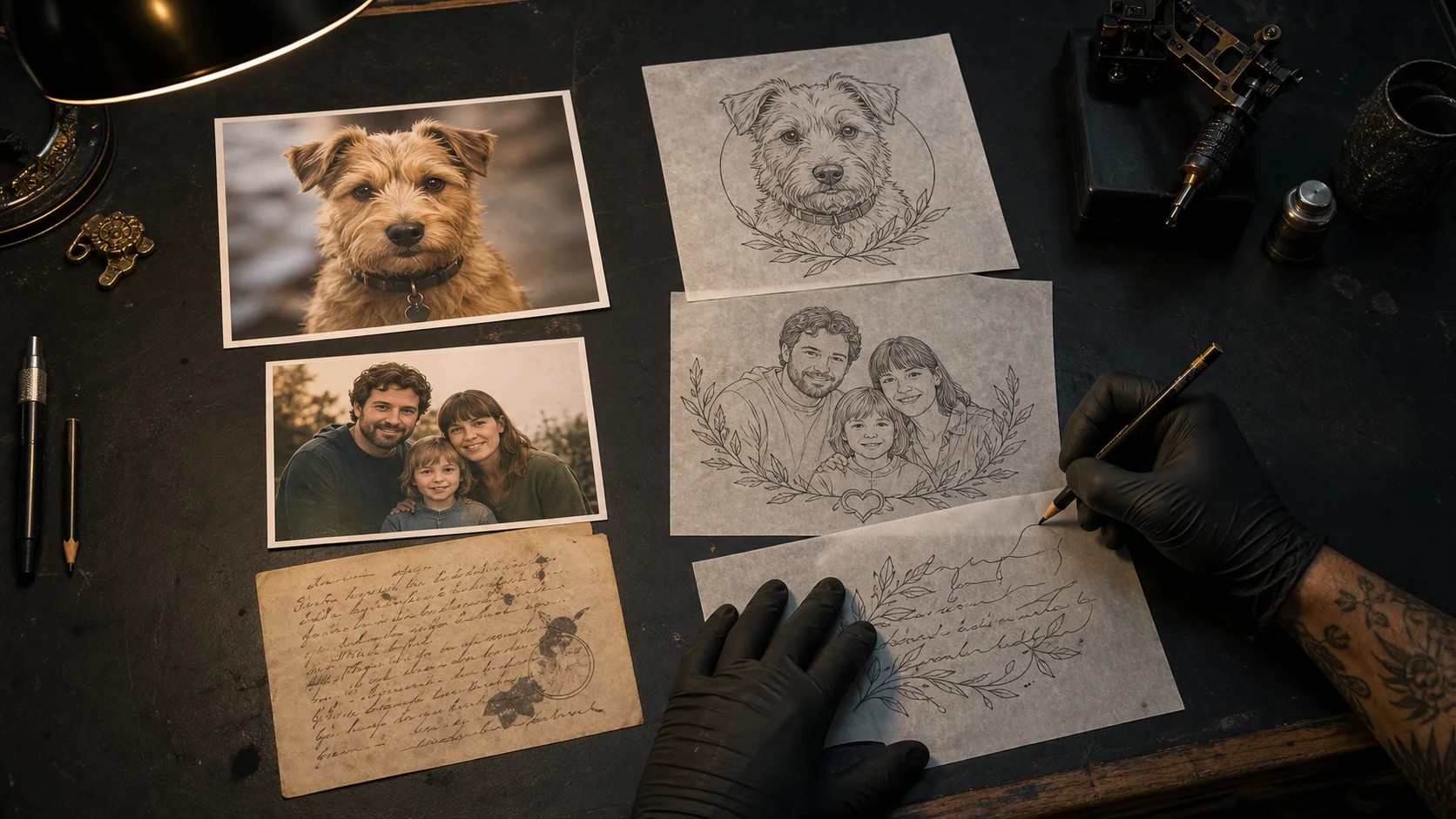
The strongest move is to bring references from the artist's own portfolio and tell them what you like about each one. "The line weight on this one, the negative space on that one." It shows you looked, it shows respect for their style, and it gets you a piece in their voice instead of a copy of someone else's. That is also how you sidestep the copy problem entirely.
Keep style and artist context attached as you go. Browse by craft in the style gallery, save from the Community Works feed, and if you want to rough out a concept to discuss — placement, scale, a loose idea of composition — the design tool is fine for a sketch to talk over. Just never walk in treating that sketch as the final design. It is a conversation starter, not a stencil.
If this is your first piece, pair your board with a starter list so you arrive at the consultation prepared. Our 15 small tattoos for first-timers and 10 tattoo ideas for women guides give you a grounded starting point without the AI noise, and they pair naturally with a tight reference board.
Where to actually find, save, and share references now
The honest stack is short. Skip AI-polluted open search for the first pass. Prioritize feeds where the work stays attached to the artist. Weight healed photos over fresh. And keep credit with every single thing you save, so the board you walk in with means something.
As the mainstream feeds keep degrading, dedicated tattoo photo communities are the durable answer — places built for real work, real artists, and reference-saving, rather than ad-driven shopping that happens to show tattoos. The grid is not optimized to sell you something. It is there to show you what people actually wear and who made it.
You have more control over your reference quality than the feed lets you believe. It comes down to where you look and what you keep. Start with a feed of real, credited tattoo work, save healed pieces with the artist's name intact, and you walk into the chair with something an artist can actually build from. Browse the Community Works feed and the style gallery and start a board worth showing.
Turn this guide into a tattoo draft
Keep the motif from this article, then test style, placement, and line weight before you talk with an artist.