Flower Tattoo Meanings: Rose, Peony, Lotus, Chrysanthemum
A chrysanthemum sits on Japan's imperial crest. Hand the same flower to a dinner host in France and you have, politely, wished her a pleasant funeral. Flowers are the most tattooed subject family on earth, and they are also the least neutral — every one of them has been talking for centuries, in several languages at once, and it keeps talking after it's on your arm.
Most people choose a floral piece by silhouette. Fair enough, petals are beautiful. But a flower tattoo is one of the rare cases where a quick look at the history changes what you ask the artist for: which bloom, open or closed, alone or paired, color or black. This is the field guide to the four that carry the most weight, plus the smaller players worth knowing.
Flowers Were a Code Before They Were Flash
Tattooing didn't invent flower meanings. It inherited them from at least three older dictionaries that don't always agree.
Europe wrote its version down in 1819, when a Parisian author publishing as Charlotte de Latour released Le Langage des Fleurs, the book that kicked off a whole century of coded bouquets. Victorians took it to the extreme: a "talking bouquet" could accept a suitor, refuse him, or call him a liar, all without a word on paper. The language of flowers reached England by way of Constantinople a century earlier, so even the Western code has Persian and Turkish roots.
Japan kept its own system, hanakotoba, and fed it straight into irezumi, where a flower is never filler — it sets the season and the moral tone of the whole backpiece. And Chinese art had ranked its blooms long before either: the peony was already the "king of flowers" when Tang-dynasty Chang'an went collectively broke buying them.
Three dictionaries, one body. That's why the same stem reads differently depending on who's looking, and why it pays to know which dictionary your design is quoting.
The Rose Carries the Western Canon
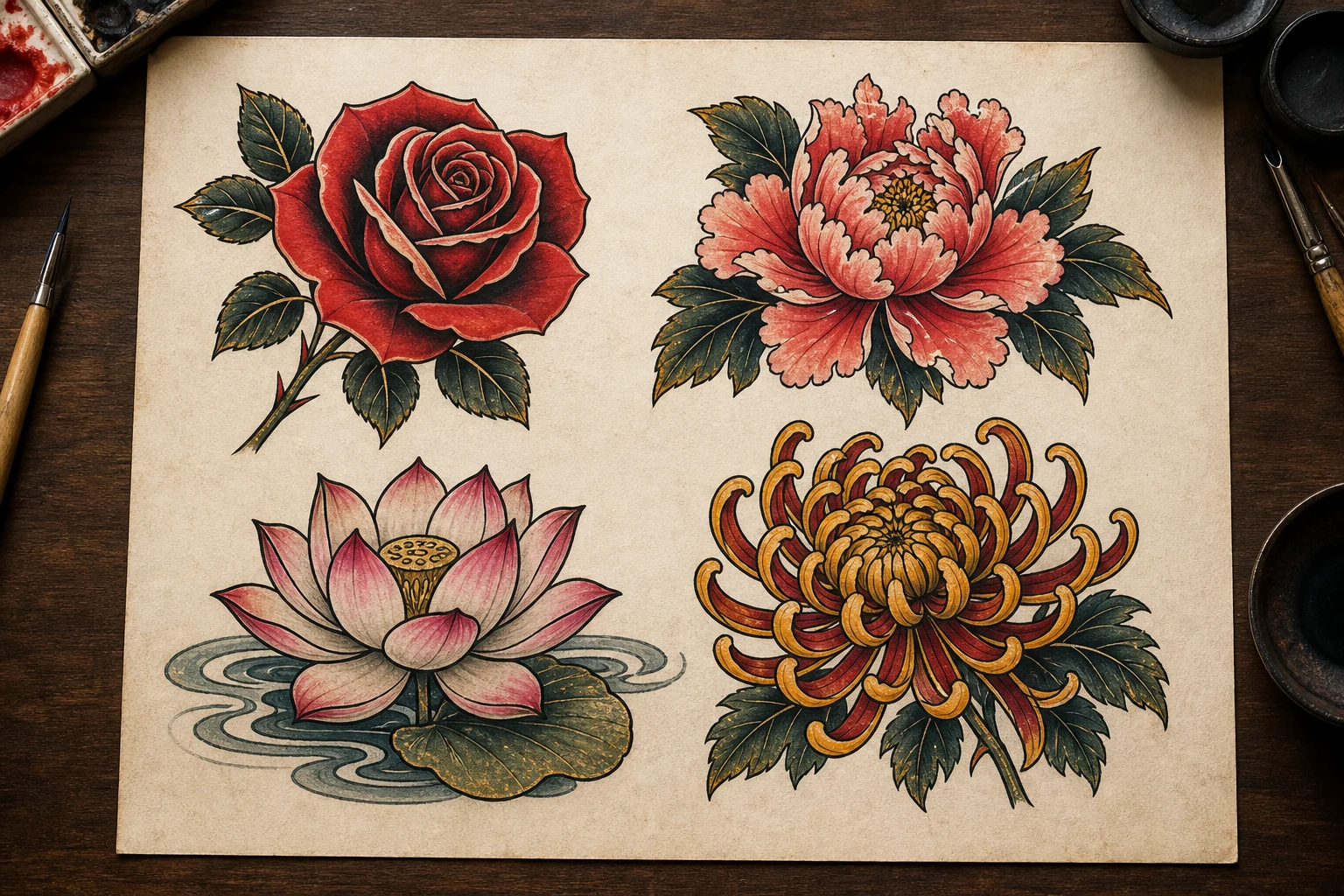
If the West has one flower, this is it. The rose entered tattooing's bloodstream through the ports: sailors wore one for the woman waiting on shore, and the motif earned its permanent seat in the American traditional canon — soft subject, hard execution, and still one of the truest tests of whether an artist can pack color.
Color does the talking. Red is love with the intensity left in. White leans toward remembrance and clean starts, which is why it shows up in memorial pieces. Yellow historically meant friendship, sometimes jealousy, depending on which Victorian dictionary you trust. Add the stem and the message shifts again — thorns kept on say the love is worth the cost, thorns stripped say it came easy.
My honest advice on execution: a traditional rose with a bold outline will outlive almost any photorealistic rose. Realism's soft petal gradients are exactly the kind of detail that twenty years of sun turns into a pink cloud. If you want realism anyway, size up and keep it somewhere clothing covers.
The Peony Answers From the East
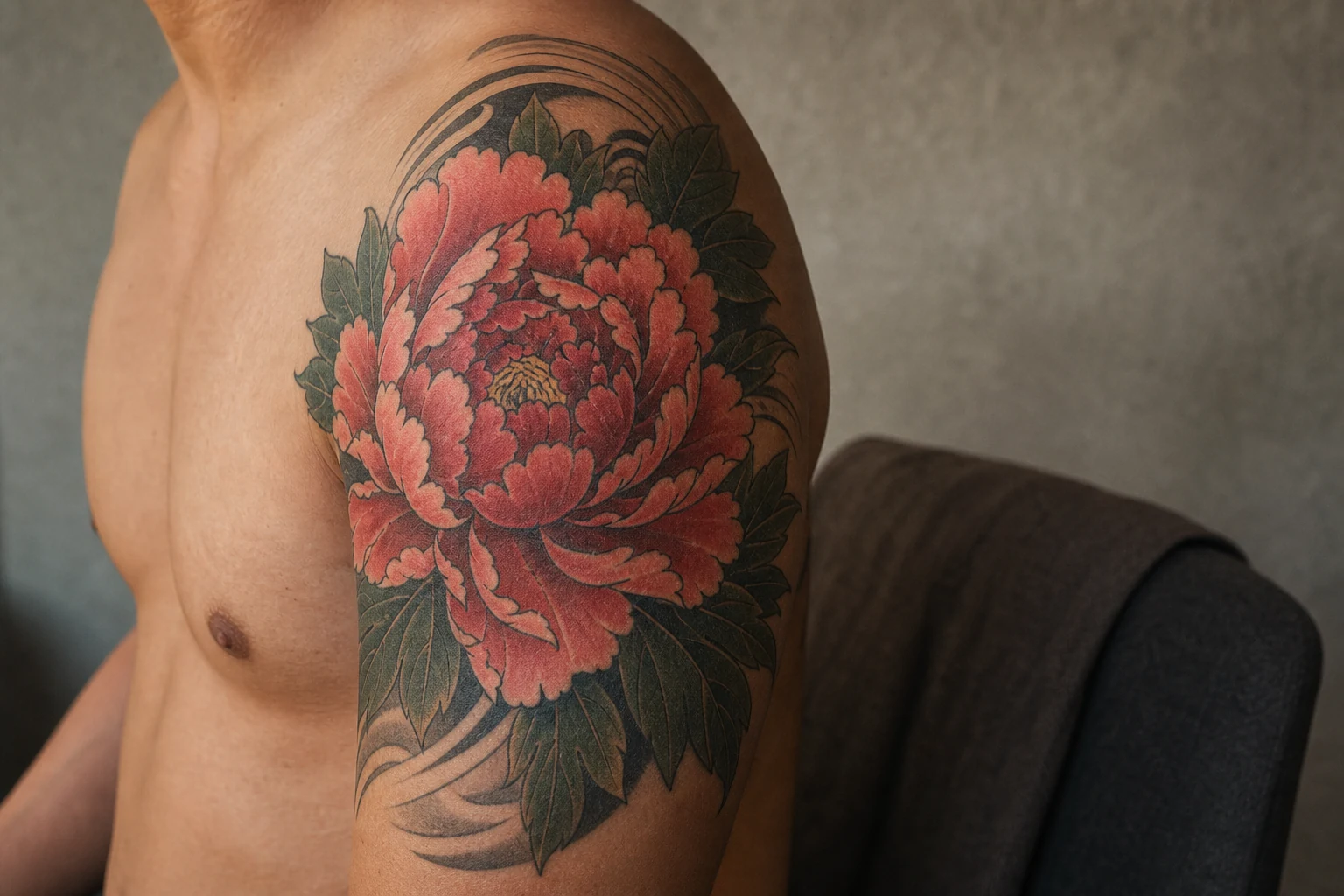
In irezumi the peony is aristocracy with a gambler's nerve. It stands for wealth, honor, and the willingness to risk both, which is why it became the flower of people who bet big. The classic pairing is the karajishi — the guardian lion wrapped in peonies, ferocity balanced by refinement. One without the other reads unfinished to a traditionalist.
The lineage is specific. Utagawa Kuniyoshi's woodblock prints of the 108 Suikoden outlaws, inked heroes covered in dragons, koi, and peonies, are the images that lit the fuse for the whole Japanese tattoo tradition in the early 1800s. When you wear a peony, you're quoting those prints whether you know it or not.
One thing the peony will not forgive is being small. Its entire identity is layered petals, and layers need room. Under palm size, the interior collapses into mush within a few years. Give it the shoulder, the thigh, the chest — a surface with real estate — or choose a different flower.
The Lotus Grows Out of Mud, Which Is the Whole Point
The lotus roots in pond muck and opens clean above the waterline. Buddhist and Hindu traditions have read that as the whole human project for over two thousand years: purity that had to come up through something dark to exist. As a tattoo it's the flower of people marking a climb — recovery, grief survived, a life rebuilt.
It's also, at this point, the default flower of every yoga studio logo on the planet, and that oversaturation is the real design problem. The fix is specificity. A tight bud says the work is still happening. A full bloom with a visible stem reaching down into dark water tells the actual story instead of the sticker version. Asymmetry, a waterline, one bent petal — anything that makes it yours instead of the font-weight version.
Worth saying plainly: this is a sacred symbol to something like a billion people. Nobody needs permission to wear one, but placement deserves thought — in several Buddhist countries, religious imagery worn low on the body reads as contempt. Keep it above the waist and you'll never have to explain yourself.
The Chrysanthemum Means Life in Tokyo and a Grave in Lyon
No flower splits harder by geography. In Japan the kiku is the emperor's seal, the highest state honor, longevity itself. In France, Italy, Belgium, and Austria, it's the flower of the cemetery — bought by the millions every All Saints' Day, laid on graves, and never handed to a living person. White chrysanthemums do funeral duty across China and Korea too. Same petals, opposite sentence.
For a tattoo, that tension is an asset if you wear it on purpose. The chrysanthemum's radial geometry is some of the best material dotwork and blackwork ever get — a hundred petals rotating out of one center, half mandala, half sunburst. A Japanese-style kiku with wind bars says endurance. A black-and-grey chrysanthemum on a memorial piece says grief with more precision than a rose ever will, precisely because of that European graveyard association.
Just know which sentence you're writing. This is the one flower where "I just liked the shape" tends to get corrected at parties, in several languages.
Birth Flowers and the Bouquet Habit
The quieter trend running through 2026 flash is the birth-flower piece — your month's bloom, or a bouquet mixing one stem per person you love. January carnation, June rose, November chrysanthemum, and suddenly the family portrait is a wrist-sized wildflower bundle. It's the rare trend with actual content: personal, expandable, and readable at small scale because wildflowers survive thinness better than layered show flowers.
The scatter approach works too — single stems collected over years, patchwork style, one per chapter. It ages more gracefully than one big commemorative bouquet, because you can add without redesigning.
Making Petals Survive Skin
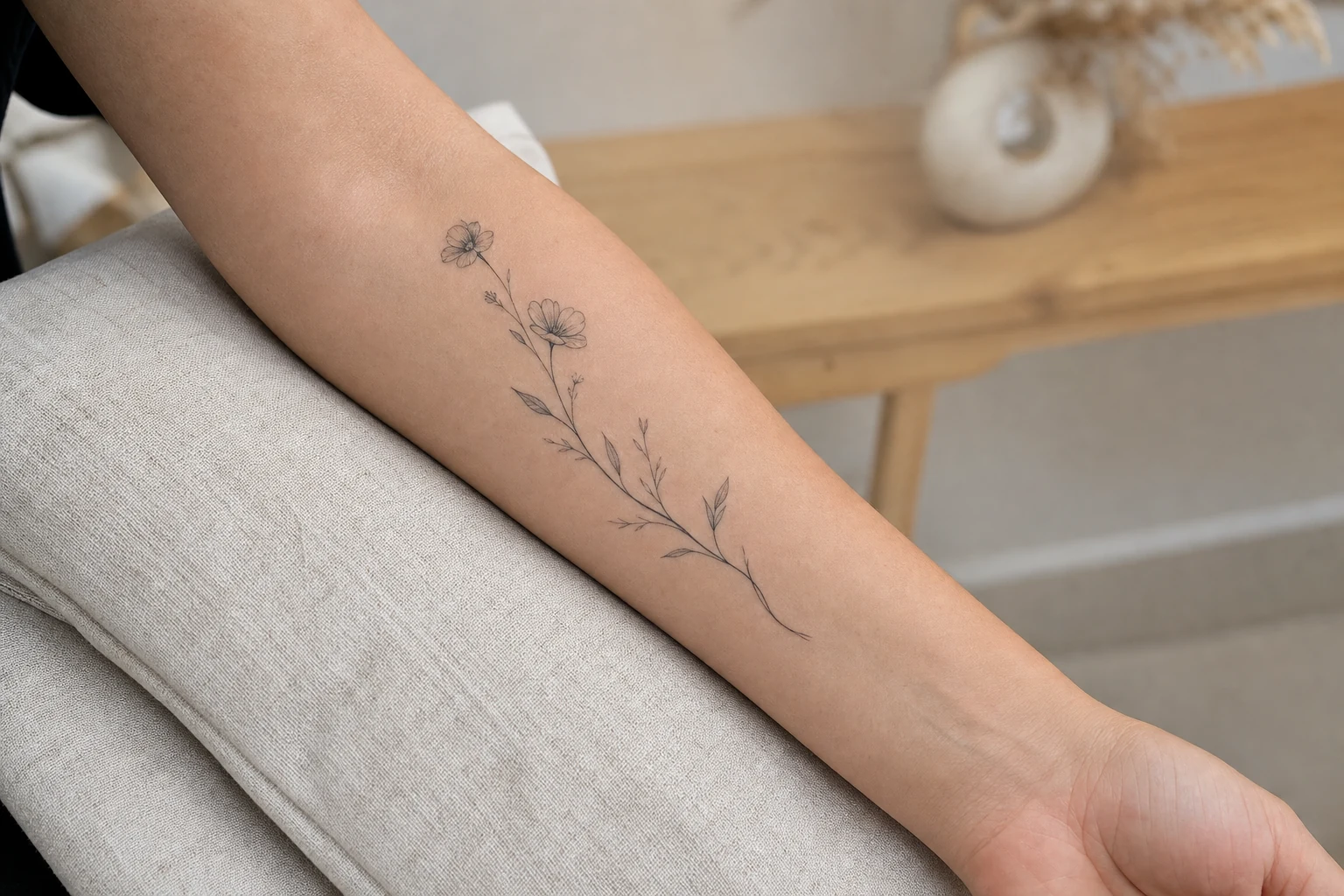
Botanical work is the most-requested fine line tattooing there is, and fine line is exactly where florals get fragile. Hair-thin petals on a knuckle or finger can soften into shadow within a couple of years; the same stem on an inner forearm, out of the sun, can stay sharp for a decade. The honest rule: the thinner the line, the calmer the placement needs to be.
Flowers also follow the body better than almost any motif — that's their structural gift. A stem wants a long bone to run along. A single bloom wants a rounded plane: shoulder cap, shoulder blade, thigh. Wrapping a bouquet around a forearm beats stamping it flat on top, because petals were never flat in the first place.
On color: packed traditional color and solid blackwork age best, soft unlined color washes fastest. Black-and-grey florals are the safe middle — they keep their drawing when the contrast drops, and they sit comfortably next to any future work.
Designing a Floral Piece With OpenInk
Flowers reward specificity in prompts the way they reward it in meaning. Instead of "peony tattoo," give the generator the dictionary entry you actually want:
"Japanese peony tattoo for the upper arm, layered petals in deep red, bold black outline, wind bars and open negative space behind, irezumi composition, drawn to stay readable at ten meters and age well"
Then adjust one lever at a time:
- Swap the bloom: rose for the Western read, lotus with a waterline, kiku with radial petals
- Close it: "tight bud, stem visible" changes the story more than any color swap
- Trade color for black-and-grey and watch the mood shift from celebration to memorial
- Wrap it: "designed to follow the curve of a forearm" beats a flat stamp
- Add the pairing: karajishi lion, snake through the rose, wind bars behind the kiku
Compare how bold and thin botanical lines behave in our fine line guide, then take the direction into OpenInk's AI tattoo generator and test it on the placement you actually mean to use.
A flower tattoo is a quote from a very old conversation. Pick the line you mean, say it in the right dictionary, and give it enough skin to keep saying it clearly when you're seventy.
Frequently asked
What does a chrysanthemum tattoo mean?
It depends entirely on where you are standing. In Japan the kiku is the emperor's seal, the highest state honor, and a symbol of longevity. In France, Italy, Belgium, and Austria it is the cemetery flower, bought by the millions every All Saints Day, laid on graves, and never handed to a living person. White chrysanthemums do funeral duty across China and Korea too.
What does a peony tattoo mean in Japanese tattooing?
Wealth, honor, and the willingness to risk both, which is why it became the flower of people who bet big. The classic pairing is the karajishi, the guardian lion wrapped in peonies, ferocity balanced by refinement, and a traditionalist reads one without the other as unfinished. Keep it palm size or larger, because layered petals collapse into mush when they are shrunk.
Which flower tattoos age the best?
Packed traditional color and solid blackwork hold up longest, and soft unlined color washes out fastest. Black-and-grey florals are the safe middle, since they keep their drawing when the contrast drops and sit comfortably next to any future work. A traditional rose with a bold outline will outlive almost any photorealistic one.
Is it disrespectful to get a lotus tattoo?
Nobody needs permission, but placement deserves thought. The lotus is a sacred symbol to something like a billion people, and in several Buddhist countries religious imagery worn low on the body reads as contempt. Keep it above the waist and you will never have to explain yourself.
Turn this guide into a tattoo draft
Keep the motif from this article, then test style, placement, and line weight before you talk with an artist.