Hannya Tattoo: The Mask That Means More Than Jealousy
Ask ten people what a Hannya tattoo means and you'll get ten versions of the same sentence: "a jealous woman who turned into a demon."
That's not wrong. It's just the first two pages of a much longer story. The Hannya (般若) is probably the single most misread motif in Japanese tattooing — partly because it looks unambiguously scary, and partly because the tradition it comes from has been flattened by a century of copy-paste flash sheets.
If you're considering a Hannya, you owe it to yourself to know what it actually carries. Because this is one of those designs where the meaning is the appeal, and getting the meaning wrong makes the tattoo smaller than it should be.
Where the Hannya Actually Comes From
The Hannya is not a folklore creature. It's a Noh theatre mask, and that origin matters.
Noh is Japan's oldest surviving theatre form — slow, minimal, stylized, and nearly 700 years old. In Noh, masks aren't costumes; they're how a single actor shifts between emotional states in front of a still audience. The Hannya specifically appears in plays about women whose grief, betrayal, or unrequited love pushes them past the line where human feeling becomes something else.
The name itself comes from hannya (般若), a Buddhist term borrowed from the Sanskrit prajñā, meaning transcendent wisdom. The traditional explanation is that the mask was named after a monk-carver called Hannya-bō, but the Buddhist echo is doing real work: a mask representing the edge of human sanity, named after the word for enlightenment. The tradition is telling you, before you even look at the face, that suffering and wisdom are neighbors.
That tension is the whole point. A Hannya isn't a villain. She's someone the tradition asks you to pity.
The Three Stages: Namanari, Chūnari, Honnari
Most tattoo references skip this part entirely.
In Noh, the transformation from woman to demon happens in stages, not all at once: a sequence of three masks, each used for a different point in the story. When you choose a Hannya for your body, you're implicitly choosing one of these stages, whether you know it or not.
Namanari (生成) — the first stage. Small horns just beginning to push through the forehead. The face still looks mostly human. This is the moment jealousy has taken root but the woman hasn't fully lost herself yet. In tattoo form, Namanari reads as ongoing struggle — the battle is still being fought internally. It's the most sympathetic of the three.
Chūnari (中成) — the middle stage. Full horns, sharper features, visible fangs. The human face is still there, but warped. This is where most Hannya tattoos actually land, even when people don't know the name for it. Chūnari represents the moment of transformation itself, caught in motion. It's the classic "Hannya expression" — simultaneously weeping and snarling, because both feelings are still present.
Honnari (本成) — the final stage. The woman is gone. Fully serpentine or demonic, no human left. In Noh, this mask is called ja (蛇, "snake") and often isn't even categorized under Hannya anymore. As a tattoo, Honnari is rare, and it carries the heaviest meaning: complete surrender to the emotion that consumed you. Most traditional tattoo artists will gently push you toward Chūnari unless you have a specific reason for the finality of Honnari.
Knowing which stage you're wearing changes the tattoo. It's the difference between saying "I've struggled with this" and "I was destroyed by this."
What the Hannya Really Represents in Irezumi
Once the mask moved from Noh stages onto skin — mostly during the late Edo period, when ukiyo-e prints were popularizing Noh imagery among working-class Japanese — its meaning stretched in ways that pure theatre tradition never intended.
In Japanese tattoo tradition (Wabori), the Hannya carries several layered meanings, and artists who know the history will often read all of them at once:
Protection against evil. This is probably the most important and least-discussed function. Because the Hannya is already a demon, she's believed to ward off other demons — the logic being that no lesser spirit wants to pick a fight with her. Worn on the chest, back, or upper arm, a Hannya is a guardian, not a threat.
A warning about your own capacity. Tattoo culture in Edo Japan was heavily shaped by firefighters, laborers, and tradesmen — people who needed reminders about discipline and the cost of losing control. A Hannya was a mirror: this is what happens when passion stops being passion. It's closer to a memento mori than a badge.
Empathy with the condemned. This one is often lost. The tradition asks you to see the Hannya not as an enemy but as a victim — someone the world broke. People who get Hannya tattoos after serious grief, betrayal, or loss are often drawing on this reading, whether they articulate it or not.
Duality and dual nature. Every traditional Hannya has both tears and fangs. The face is designed to look different depending on the angle — from below, sorrowful; from straight on, enraged. That visual trick is why Hannya tattoos work so well on curved body surfaces like the chest or deltoid: the piece literally changes expression as you move.
None of these readings cancel out the "jealousy" one. They just make it the surface layer of something much deeper.
Mainstream Hannya Tattoo Styles
There are four broad directions most modern Hannya tattoos fall into, and the one you pick should match what you're trying to say.
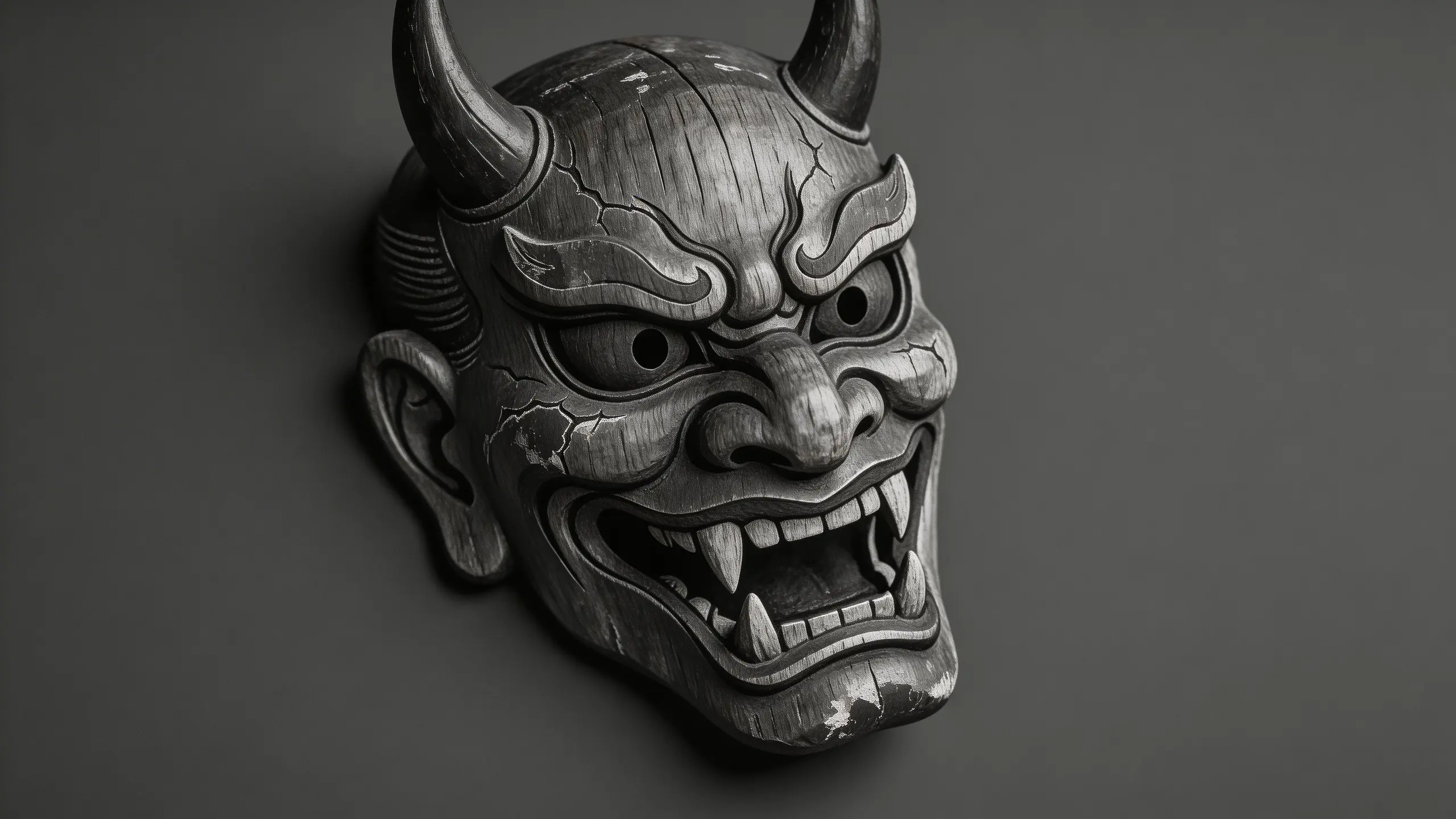
1. Traditional Wabori (Full Japanese)
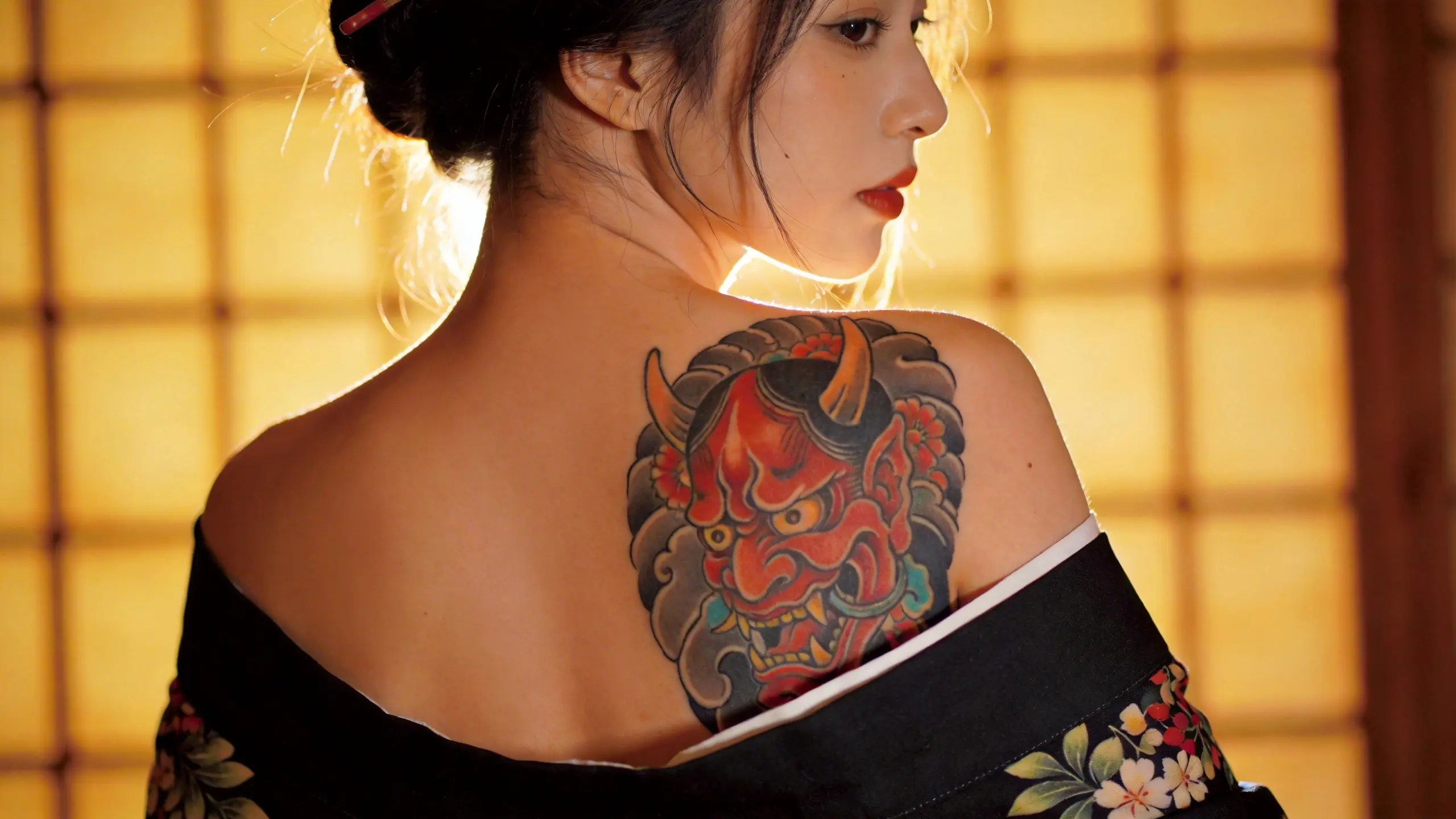
The classic approach. Heavy black outline, saturated red and white on the mask, backed by maple leaves, peonies, or churning waves, and tied together with Gakubori (cloud and wind-bar backgrounds).
This is the version you see on full sleeves, chest panels, and backpieces. It's the most historically grounded, and it's also the most demanding of real estate — a traditional Hannya doesn't look right crammed into a small space. If you're going this route, plan for at least a half-sleeve or larger. The background work isn't optional; it's what makes the mask feel situated inside a story instead of floating on skin.
The best Wabori Hannya pieces pair the mask with seasonal elements that reinforce the emotional reading. Maple leaves (autumn, decay) deepen the tragedy. Peonies (wealth, yang, masculine power) create contrast. Cherry blossoms, counterintuitively, pair beautifully with Hannya because both symbols share a meditation on impermanence.
2. Neo-Japanese
Same compositional logic as traditional Wabori, but with modern palette choices, finer lines, and sometimes a looser approach to the rules. Neo-Japanese Hannya pieces often introduce gradient work, unconventional color choices (teal, violet, desaturated reds), and slightly more realistic shading.
This style works well for people who want the cultural weight of the motif without committing to the strict traditional aesthetic. It's also easier to fit into a medium-sized piece — forearm, upper thigh, calf — because the compositional rules are more flexible.
The risk with Neo-Japanese is drift: once you start bending the rules, it's easy to keep bending them until the piece stops reading as Hannya at all. A good Neo-Japanese artist knows which rules are ornamental and which ones are load-bearing.
3. Black and Grey Realism
This is where Hannya tattoos have gotten some of their most striking modern reinterpretations. Done in photorealistic black and grey, the mask reads less like a theatrical object and more like a sculpted artifact, all texture, shadow, and weight.
Black and grey Hannya work especially well when you want to foreground the object-ness of the mask: the carved wood, the worn paint, the age. It pulls the motif away from fantasy-demon territory and back toward its Noh origins.
Placement matters a lot with this style. Black and grey realism needs skin that can hold fine gradients — the upper back, outer thigh, and chest all work well. Avoid placements with heavy stretching or creasing (inner elbow, back of knee) where the shading will distort over time.
4. Illustrative / Contemporary
The newest direction, especially popular with younger collectors: Hannya reimagined through the lens of illustration, graphic design, or even anime influence. Bold, flat color. Unusual framing. Sometimes deliberate asymmetry or stylized horns.
This style trades tradition for personal voice. Done well, it produces some of the most memorable Hannya tattoos out there — pieces that clearly reference the motif without trying to replicate historical Wabori. Done poorly, it becomes a character design that happens to have horns.
If you're drawn to this style, find an artist whose illustrative portfolio you actually love outside of Hannya work. Their voice is what you're buying.
Placement and Composition Notes
A few practical things worth thinking through before you commit:
Scale up before you scale down. Hannya is a face, and faces need real estate to breathe. A small Hannya loses the fine expression work that makes the mask powerful — the tears, the angle of the mouth, the subtle asymmetry between the two sides of the face. If you want something small, consider a single element (a single horn, a partial mask) rather than a miniature full face.
Orientation tells a story. A Hannya tilted downward reads as grief. Tilted upward reads as defiance or rage. Level reads as confrontation. Most artists default to a slight downward tilt because it honors the tradition's sympathetic reading, but this is a choice worth discussing explicitly.
Pair with intention, not with reflex. Serpents, peonies, maple leaves, and waves all pair well with Hannya, but each changes the emotional tone. Snake coils around the mask emphasize entrapment. Peonies soften the reading. Maple leaves emphasize tragedy. Waves place the mask inside a larger Irezumi composition and make it feel like part of a story rather than a standalone portrait.
Avoid the common shortcut. A Hannya floating alone on bare skin with no background is the most common mistake in Western Hannya tattoos. It looks unfinished in the Japanese tradition and, honestly, a little confused — the mask was designed to exist inside a scene. Even minimal background work (a suggestion of clouds, a few scattered leaves) anchors it.
Common Misconceptions Worth Clearing Up
"Hannya is a demon." Not quite. She's a human who became a demon — and the story is specifically about that transformation, not about a demon that always existed. The sympathy for the human she was is central to the motif.
"Hannya is bad luck." Some flash-sheet lore claims Hannya tattoos bring misfortune. There's no meaningful basis for this in Japanese tradition. The protective reading is far older and more established than the "bad luck" warning, which mostly appears in Western tattoo communities.
"It's a woman-only tattoo." Hannya has been worn by men throughout the history of Japanese tattooing, often specifically for the protective meaning. The mask's origin in stories about women doesn't restrict who can carry its symbolism.
"Any Hannya is basically the same." We covered this above — the three stages (Namanari, Chūnari, Honnari) and the four style directions give you a real vocabulary to work with. Treat them as meaningful choices, not aesthetic presets.
Designing Your Hannya with OpenInk
If you're still at the "I know I want a Hannya but I can't picture exactly what it should look like" stage — which is where most people are — try being specific with your prompt. Something like:
"Chūnari-stage Hannya mask, traditional Wabori, tilted slightly downward, surrounded by autumn maple leaves and ink-wash clouds, red and white palette, half-sleeve composition for the upper arm"
The more compositional intent you give the AI, the more useful the output. Try varying the stage (Namanari vs. Chūnari), the style direction (traditional vs. neo-Japanese), and the background elements to see how each choice changes the emotional register of the piece. You can then fine-tune expression details — how much of the tear is visible, how sharp the fangs are, how human the eyes still look — in InkCanvas before bringing your favorite version to a tattoo artist for the final consultation.
Whatever you end up with, try not to reduce the Hannya to a single emotion. The reason this mask has lasted 700 years is because it holds more than one feeling at the same time. A good tattoo should too.
Turn this guide into a tattoo draft
Keep the motif from this article, then test style, placement, and line weight before you talk with an artist.