Engraving-style tattoo sleeve design, full arm from chest/clavicle throug...
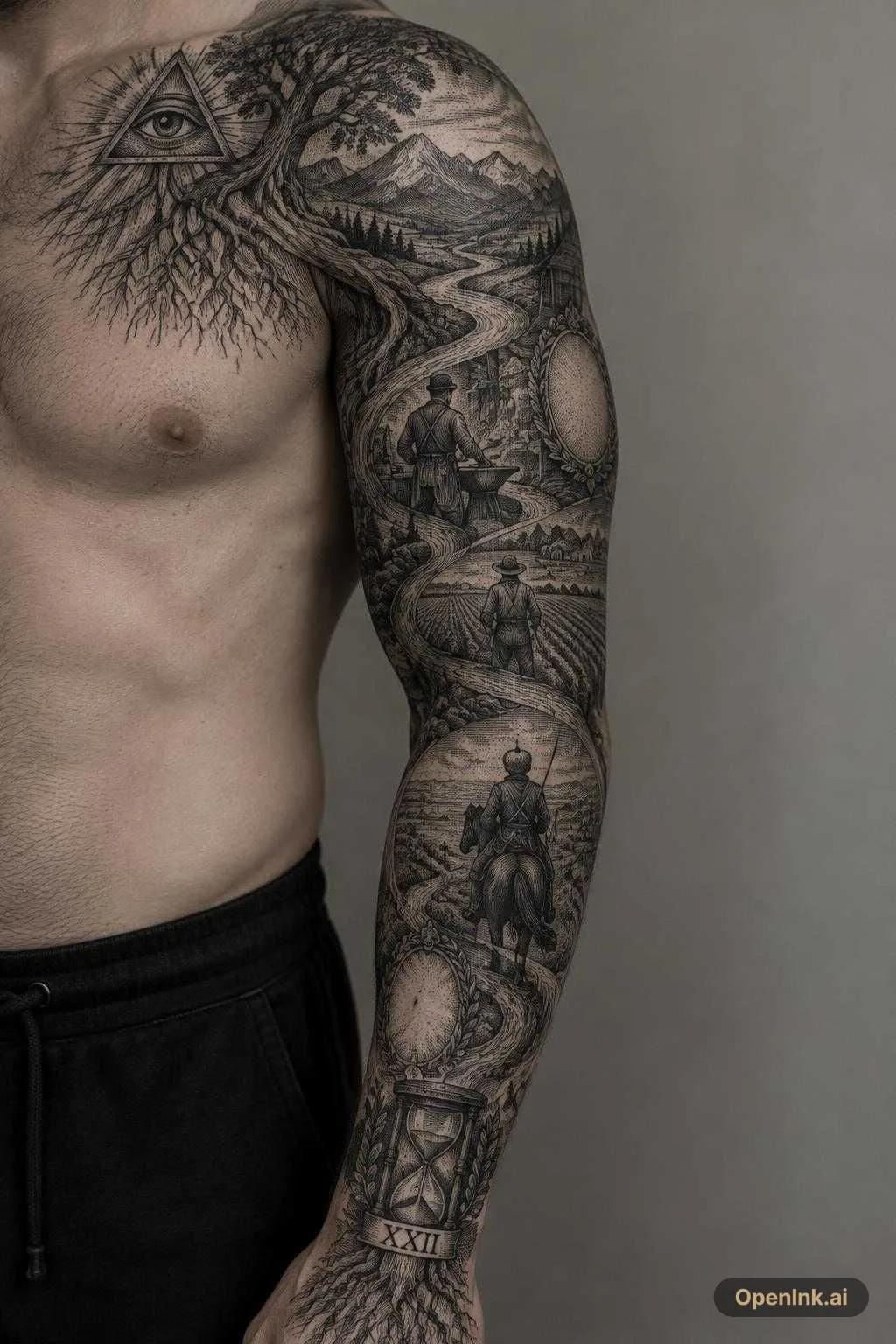
"Engraving-style tattoo sleeve design, full arm from chest/clavicle through shoulder and outer arm to wrist, strictly black and white, etching / copperplate engraving technique, dense cross-hatching, stippling, fine lines, no color, no shading gradients. Unified flowing composition along an S-shaped axis — simultaneously a root, a river and a road — connecting all scenes without hard borders. Two family branches flow as two streams and merge into one river of time. All human figures are shown from behind, as silhouettes, hands only, period clothing, no faces; empty oval portrait frames and shadowed profiles symbolize unknown ancestors. No religious symbols (no crosses, crescents, stars). No political symbols, no flags, no coats of arms. IMPORTANT — existing tattoo: the wearer already has a Masonic eye tattooed in the center of the chest. Do not cover it — integrate it as the starting point of the composition: engraved tree roots grow outward from the eye, wrapping an empty oval frame, hands passing a small object. The eye stays readable. From chest to wrist, top to bottom: 1. Chest — around the existing Masonic eye: gnarled tree roots growing from the eye, wrapping an empty oval frame, hands passing a small object between them. 2. Shoulder — Prussian line (Galbakh): 18th–19th century gunsmith workshop of Prussian German subjects of the Russian Empire — workbench, hammer, file, a saber resting (not in battle), silhouette of a factory workshop and Ural mountains in the background, a stream flowing (Bach motif), metal shavings curling into water. Subtle hint of Prussian origin through period clothing and architectural silhouette only — no flags, no heraldry. 3. Biceps — maternal line (Dubrovins): mighty oak tree and oak grove, silhouette of a manor house with empty windows, heavy fabrics, candlestick, another empty frame — noble ancestry with unknown occupation. Nearby: a female doctor and a male dental technician, shown from behind — antique medical instruments, apothecary bottles, anatomy book, plaster casts/dental prosthetics, working hands, no faces. 4. Elbow (darkest, densest hatching): thin line of barbed wire interrupting the river of time, a hunched silhouette in a military greatcoat seen from behind, a helmet on the ground — quiet memory of a great-grandfather lost in a penal battalion, no politics, no glorification. Empty frames for unknown great-grandmother and great-great-grandmother. 5. Forearm — paternal line: female farmer in a headscarf seen from behind, wheat field, pitchfork, farm animals (cow, chickens, horse); male veterinarian shown from behind examining a horse/cow, antique veterinary instruments, working hands. Empty frames for unknown great-grandmother and great-grandfather. Additional family name Korokhov — integrate as a subtle engraved motif (wooden box / wood / craft), no lettering, no clutter. 6. Forearm/wrist — Tatar line (Bikkulovs): steppe landscape, feather grass, horizon, a horseman seen from behind, a horse by the water, a yurt/tent, Tatar floral-geometric ornament (non-religious). 7. Forearm — parents: father as a craftsman, seen from behind — woodworking tools (plane, saw, chisel), wood shavings, timber house frame, furniture silhouette, a simple wooden coffin as a craft object (subtle, not macabre); mother as a homemaker, seen from behind — hearth, kitchen, sewing, keys, preserving jars, home silhouette. 8. Wrist — the wearer and his wife: both deaf, shown through a restrained old-school metaphor executed in engraving style — two severed ears lying on a table or held in hands, no blood, no gore, no naturalism, styled like an antique anatomical illustration or copperplate engraving. No crossed-out ears, no tears, no pity. Nearby an hourglass or pocket watch, a hand passing an object onward, composition curling inward and fading into skin. Wedding date — XXII September 2026 (number 22 in Roman numerals) — integrated delicately: either as an engraved date inside a clock face / hourglass (Roman numerals), or as text on a ribbon/scroll, or as two clock hands frozen at 22:09. Small, refined, antique engraving style, no large lettering, no modern font. Mood: mixed — epic and quiet, dramatic and philosophical, a sense of path, roots, memory and the question of existence. Style references: Dürer's Melencolia, old anatomical and botanical engravings, antique encyclopedic illustrations, Gustave Doré. High detail, tattoo stencil quality, clean linework, balanced dark and light areas, readable at arm scale. Aspect ratio: vertical, full arm length."